Category Archives: Default

When Earthly Romance is Easier to Pray About Than Divine Romance

When you walk into the room, everything changes. [My] heart is Yours, [I] want You. Search me, know me, know my every thought…consume me now.

He drew my attention to the language of pursuit. Depending on your current situation, songs like “When You Walk Into the Room,” “Fresh Fire,” and others might sound like a head-over-heels crush, like the electricity of first falling in love, or like the desire to go deeper in a longtime relationship–and all of those interpretations would be accurate. Our God is a God of love; Love incarnate, in fact. 

I knelt beside my family at a recent Festival of Praise and let the words of worship wash over me. Man, I thought. When did Praise and Worship get so romantic? …Do I like this?

This reflection won’t be a critique of worship lyrics. It’ll instead look at why this thought crossed my mind, and all the beautifully varied ways the Lord speaks to our hearts.

The image of spousal, even romantic, love, rings so clearly in vocations to religious life and the priesthood: Jesus, the bridegroom; the Church, the bride. But if, like me, you are called to the vocation of marriage, do you ever find it more challenging to think of Christ in this way?

If you have a human spouse, particularly one who strives to embody a Christ-like love, the actual image of Christ as a bridegroom, as a lover, might feel less preeminent because you experience espousal in a concrete, daily way…just me? I’m blessed by a husband who is supremely sacrificial, tender, forgiving, and strong, who takes seriously the call to love “even as Christ loved the church and handed himself over for her” (Ephesians 5:25). Of course, we’re imperfectly human and frequently falter in our efforts to love, yet I do find deep fulfillment and joy in my marriage. It’s a balancing act in some ways, living in the tension of knowing earthly marriage is so good and fruitful while also staying aware that it’s an image of the even greater wedding banquet to come (Cf. Revelation 19:9).

So maybe, within the contentment I feel in the marital love of my husband, that’s why I don’t consider the marital love of Jesus as readily. As I prayed with the worship music, I felt the Lord asking me how I see His divine love intersecting with the earthly love for which I feel such gratitude in my vocation. What does make you feel pursued? He asked. What do you find romantic?

The answer arose quickly: conversation. I laughed as I recalled the marvel of discovery and curiosity I felt as I was first getting to know my husband. We spent hours writing messages as friends and, later, asking question after question over coffee and dinner. I felt constantly and utterly amazed at the person who was being revealed to me. 

Inspired, I had the thought of inviting in the Lord in this same manner. Jesus, ask me a question, I prayed. Let my interior thoughts, so often a monologue, be more of a dialogue–with You. I’m hopeful and eager for what He’ll ask me, and how our relationship will deepen in my responses.

If you’re engaged or married and could use a similar perspective shift with romance in the divine sense, reflect today on what stirs in your own heart when you feel the joy of being sought after by your spouse. How can you invite the Lord to meet you there? 

Your love language might offer a starting point. I, for instance, deeply value quality time and conversation, and felt Jesus prompting me to converse with Him as much as I do with my husband. If you feel most loved by words of affirmation, ask the Lord to speak His words over you, professing your identity and specific worth. The love language of acts of service might inspire opportunities to meet Him in your work, volunteering, or family life. The language of gift-giving might find the Lord encouraging you to come before Him with big asks and radical trust; “You pay God a compliment by asking great things of Him” (Escaleira, André. (2023, 14 October). Wise Words from Avila: 10 Quotes from Saint Teresa. Denver Catholic.). Physical touch? Perhaps He wants to reveal something new to you in the sacraments. 

Let your heart be sought after, pursued, and romanced. Let it be more deeply beloved, and let Him surprise you. “…prayer can progress, as a genuine dialogue of love, to the point of rendering the person wholly possessed by the divine Beloved” (John Paul II. (2001, 6 January). Novo Millennio Ineunte, 33).

September: Suicide Prevention Awareness Month

September is National Suicide Prevention Awareness Month. Every day, around 123 Americans die from suicide. Annually, around a quarter of a million Americans will survive an attempted suicide.

Phone calls to suicide hotlines have skyrocketed. According to the Center for Disease Control, the number of people reporting thoughts of suicide has more than doubled from 4% in 2018 to 11% in June 2020. Even before the pandemic, suicide rates had been increasing over the past several years. In 2018, The National Center for Health Statistics reported that suicide was the tenth leading cause of death in the United States and the second leading cause of death in people ages 15-34. And, while women attempt suicide three times more often than men, men are three times more likely to have a fatal outcome.

Because the number of suicides and suicidal attempts continues to climb, the number of people affected by it has increased, as well. If you or someone you love needs support, please reach out. A trusted priest or your diocesan marriage and family life director can help you get started.

Church Teaching

“Man has been given a sublime dignity, based on the intimate bond which unites him to his Creator: in man there shines forth a reflection of God himself” (Pope Saint John Paul II, Evangelium Vitae, 34).

Recognizing that the human person is made in the image and likeness of God, the Catholic Church proclaims the dignity of all human life from conception until natural death. Every person is responsible for his life which is freely given to him by God. Because of each person’s inherent dignity, the taking of one’s own life is contrary to the love of God who gives us life, the love of our neighbor to whom we have obligations, and a just love of the preservation of one’s life (CCC 2280-2281).

While the Church recognizes the grave objective evil of suicide, She is a compassionate mother who recognizes that “grave psychological disturbances, anguish, or grave fear of hardship, suffering, or torture can diminish the responsibility of the one committing suicide” (CCC 2282). God alone is the judge of our actions and intentions. As such, “We should not despair of the eternal salvation of persons who have taken their own lives…The Church prays for persons who have taken their own lives” (CCC 2283).

The heart of the Church is the heart of a mother who holds particularly close all her children who suffer, especially those who are affected by depression, anguish, or the loss of a loved one to suicide.

USCCB Resources

Other Resources

Our Children are not Just the Future of the Church

The church was holding Mass in the community center, which meant there was only a crucifix and a tabernacle behind the altar. There was no religious art, and while the space was reverent, it was aesthetically sparse, which seemed to make it even harder to focus as my children wiggled in their seats. As we knelt for the consecration, I tried to close my eyes and block out the distractions. As he sometimes does, my husband, Joseph, whispered to our older son to encourage him to pay attention to the prayer. Ronan listened but continued to wiggle and ask questions and generally behave like most five-year-olds in church. At one point he asked, as he usually does, “How much longer?” When Mass ended, we trudged in the heat to our car, strapped our kids into their seats, and headed home, relieved to have survived another weekly Mass with small children.

“Oh, by the way,” Joseph said. “During consecration, Ronan said he saw angels.”

I looked over my shoulder at Ronan and he smiled. When I asked where he saw them he said, “All around. When the priest held up the bread and when he held up the cup.”

“What were they doing?” I asked.

“They were singing.”

“What were they singing?”

“‘Glory to God in the Highest.’”

“Wow,” I said. “That’s pretty special.”

Since that Mass, Ronan has claimed he sees angels during consecration every Sunday. He says it looks like faint white lines in the shapes of angels and that they are always singing very softly.

We’ve tried not to put too much pressure on him to describe it, as he’s a very imaginative child and we know small children will often say the things they think you want to hear. We’ve only told him it’s a wonderful gift to be able to see angels, and we’ve talked about the significance of them appearing as the priest raises the host and the chalice.

But I keep returning to the thought that God’s ways are both strange and wonderful. So often, Ronan whines that he doesn’t want to go to church. He fights us when we tell him he needs to stand or kneel or pay attention during Mass. At prayer time, he rushes through the Hail Mary so quickly the words run together. In other words, he’s a normal five-year-old. While he is loving and kind and full of deep questions, there is nothing about my son that would make me believe he is deeply holy already, a tiny St. Padre Pio. And yet, while I strained to keep my wandering mind focused on the most pivotal moment of Mass, my son saw angels and it was barely even a surprise for him.

As Catholics, I think we often believe that holiness must follow a specific script. We believe it looks like perfect stillness and constant reverence; it’s never complaining and total surrender. But I think God is challenging me to see it as something much more complex—every person, at every stage, might be called to holiness in a different way. My son, too young to understand most things about the faith, full of his little selfish and childish wants, unable to sit still, is holy. He is holy by his baptism, holy by the grace of God, by His unfathomable generosity to let him glimpse beyond the veil.

I know that at every Mass, there really are angels praising the glory of God. Though we cannot see them, we are gifted every opportunity for holiness in the Mass, in the Word and Bread of God. Furthermore, as a parent, I’m gifted the opportunity to find holiness even in the wiggles and tantrums of my children. So often, at Mass, I blame myself for my distractions, for my lack of feeling as I receive the Body of our Lord. But Ronan’s claim of seeing angels has been like a wakeup call, reminding me that my holiness is not based on how well I pray or even how well my children behave. Rather, holiness is a gift from God, granted by His love and His sacrifice.

We are told that children are the future of the Church, a wonderful reminder to parents of small children that, despite the struggles, it is worth it to bring our kids to Mass. But I believe we can take it one step further. Children, as baptized members of the Body of Christ, are the Church already. What if we began to see the sound of a baby’s cry, the strained whispers begging our toddler to sit down, the goldfish crumbs in the pews, the little limbs sprawled across a kneeler, the sibling squabbles over who gets to put the envelope in the offertory basket—all of it not as distractions but rather intrinsic parts of the Mass, like sacramentals aiding in our path to holiness. All of it bound up and made holy in the Sacrifice of the Mass.

Even if I’m dragging my three-year-old to the bathroom or telling my five-year-old to stop chewing on his shirt sleeve, there are still angels singing around us. Every one of us—no matter how young, how old, how distracted, how hungry, sleepy, bored, whiny, or struggling—is called to holiness and meant to be at the Table.

Newlyweds in the Time of Coronavirus

Here we sit, nice and cozy on a rainy spring morning, laptops out, sipping tea, and working from home. Like most Americans, our home – a one-bedroom apartment – is now acting as our temporary office, school, and even church. Unlike most people, though, Eric and I were just getting the hang of living under the same roof! We have been married for just over four months. There are still boxes to unpack, thank you notes to send, and we are still figuring out our daily rhythm as a married couple. Now we have every waking and sleeping moment together for what looks like at least a month; it’s a perfect opportunity to grow together as a couple.

We are thankful for this extra time together. It is the most quality time we have been able to spend with each other since our honeymoon. So far, it has been a time of renewal, almost like a newlywed bootcamp/retreat. We both work full time, so, until now, being at home together was only a few precious hours before it was time to crawl into bed. But, since we have been home, we have enjoyed taking long walks in the beautiful spring weather. These walks offer an opportunity to reconnect – reflecting on our marriage thus far and talking about our dreams for the future.

It is also a time for us to reconnect on a spiritual level. Like most people, in addition to our closed offices, we are unable to attend Mass until further notice. For the first time in our lives we are not able to go to Mass on Sunday. This unusual circumstance has given us the opportunity to come to a more profound understanding of our identity as a domestic church. About a month ago, I unpacked enough boxes to find and hang some of our sacred art in a place of prominence in our living room. Underneath is a trunk to act as our altar, adorned with flowers, candles, and sacramentals. Our little prayer altar has assumed a new special meaning at this time.

Another blessing of spending more time at home is the opportunity to re-engage in those creative activities and hobbies that easily get pushed aside on our busy normal days. Eric has picked up his trumpet again (practicing with the mute on so as not to disturb our neighbors!) and I have dusted off my watercolors and picked up embroidering. Both of us are reading for pleasure again and we even have designated time to read together.

Obviously, quarantine also has its share of challenges. When people are in the same place together for an extended period of time, there is going to be friction. What would be small disagreements, misunderstandings, and frustrations can get blown out of proportion when we are in close quarters. But even these can be blessings because we have nowhere to go and no choice but to work through them! We are learning to communicate better and to love in difficult moments. We each have plenty of opportunities to grow in the virtues of patience and compassion towards the other.

So, there it is, we are taking life one day and one step at a time, as I am sure you all are, too. As I write, I’m reminded of Matthew 6:25-34, most specifically verse 34, “Therefore do not be anxious about tomorrow, for tomorrow will be anxious for itself.” Each day is filled with a blessing from God. As of now, neither of us is sick, but if that happens, we’re prepared to make good on that vow to be there for the other in sickness and in health.

We pray this will be a time of growth for us in every way, but especially in our faith, our identity as a domestic church, and in our ability to love one another with the selfless love which our vocation calls us to. God bless you all. You are in our prayers in these uncertain but grace-filled times.

About the Author
The newly-minted Theresa Lewis has been married to her husband Eric since November 23, 2019. A few years before that, Eric and Theresa both spent time discerning religious life. God had different plans for each of them and they could not be happier that he brought them together! Theresa holds a BA in theology and history from Benedictine College and an MEd in secondary education from Creighton University. After teaching for several years, Theresa has become the program assistant to the LMFLY Secretariat at the USCCB. The newlyweds reside in a cozy apartment in Washington, D.C.

Resources for Responding to COVID-19

Below is a working list of resources to assist in the work ministering to families and engaged or married couples during these uncertain times.

*Please not that inclusion in this list does not indicate any form of endorsement.*

For resources in Spanish, please visit our sister site, Por Tu Matrimonio – Resursos para responder al COVID-19.

Prayers

Mass and Adoration Livestream

Prayer and Liturgical Resources


The following publishers have generously made their resources available to support prayer during these difficult days. We thank them for their generosity and pastoral concern.

Tools for Ministering Online

E-Resources for Ministry and Couples

Diocesan Initiatives

Resources/Articles for Parents and Families

Coronavirus

Faith and Prayer

Fun Activities

Teaching Children at Home

Prayer and Mass for Children

Children’s Activities

Children’s Videos and Podcasts

Talking to Children

More resources can be found on the USCCB website: usccb.org/coronavirus

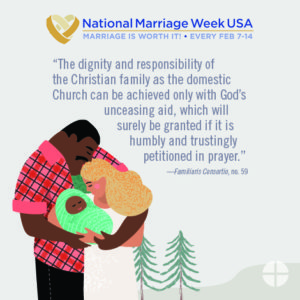
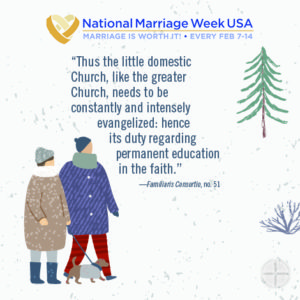
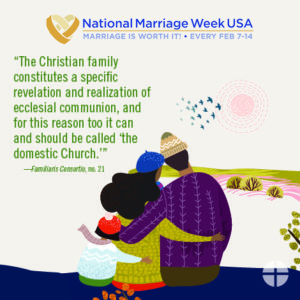
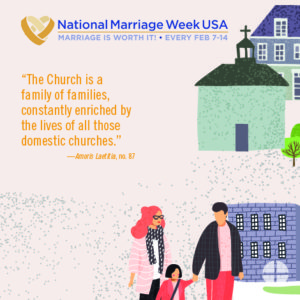
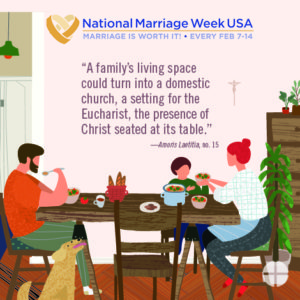
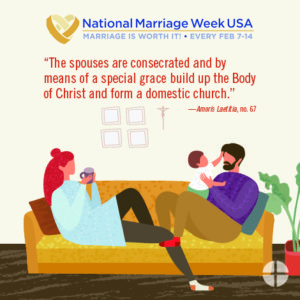
National Marriage Week 2020 Social Media Kit

Spread the word about National Marriage Week 2020: Stories from the Domestic Church by updating your cover photo or sharing one of our social media images.

To download the image, right click and select “Save image as…” You can post the images yourself or during National Marriage Week 2020, you can share posts from the ForYourMarriage or USCCB Facebook pages.

Facebook Cover Photo


Social Media Graphics

(Each image is 400×400.)

National Marriage Week 2021 Social Media Kit

Spread the word about National Marriage Week 2021: To Have, To Hold, To Honor by updating your cover photo or sharing one of our social media images! Graphics are suitable for Facebook and Twitter and are available in both English and Spanish. Scroll down to see all available options!

To download the full-size image, click on the image, then on the next page right-click and select “Save image as…” You can post the images yourself or during National Marriage Week 2020, you can share posts from the ForYourMarriage or USCCB Facebook pages.

Graphics for Facebook in English


Graphics for Facebook in Spanish


Graphics for Twitter in English


Graphics for Twitter in Spanish


National Marriage Week 2022 Social Media Kit

Spread the word about National Marriage Week 2022: Called to the Joy of Love by updating your cover photo or sharing one of our social media images! Graphics are suitable for Facebook and Twitter and are available in both English and Spanish. Scroll down to see all available options!

To download the full-size image, click on the image, then on the next page right-click and select “Save image as…” You can post the images yourself or during National Marriage Week 2020, you can share posts from the ForYourMarriage or USCCB Facebook pages.

Graphics for Facebook in English and Spanish

Graphics for Twitter in English and Spanish


NFP Saved My Health—Naturally!

When only seventeen, I experienced my period every other week. My greatly concerned mother took me to see her gynecologist who promptly prescribed the birth control pill. This, the doctor did, though she performed no tests to discover why the frequent menses.

Uninformed about the dangers of hormonal contraception, and desperate for a relief, I happily accepted the medication. About a year later, however, I learned about the negative effects of hormonal contraception. I decided it was not good for me. Returning to the doctor, I asked for an alternative treatment. I was told that there was nothing that could be done for me.

Throughout my college years, I resigned myself to a fate of irregular and painful menstrual cycles. During this time, I had also suffered a number of ovarian cyst ruptures. Unfortunately, I did not dig into the causes of my reproductive health problems until later in marriage preparation when I first started tracking my menstrual cycles through Natural Family Planning (NFP). I worried that my condition would make NFP difficult to practice. And, in fact after I married, the first few months were difficult. My charts were confusing. My husband and I spent hours studying the charts trying to figure out what was going on. I became convinced that something was happening. The clear data empowered me. Not only did I know that there was something wrong, but I knew I could prove it!
After a few months of tracking my cycle, I went to see an NFP trained gynecologist. The doctor reviewed my charts, treated them as medical records, and ordered a number of tests to check my hormone levels. Many medical appointments, charts, and blood draws later, the causes were discovered.

I was diagnosed with both Polycystic Ovarian Syndrome (PCOS) and Hashimoto’s Thyroiditis (an autoimmune condition). Though my irregular cycles and difficulty charting seemed like a confusing burden at first, they ended up being my saving grace. It was only through NFP that I was able to recognize the physical signs telling me that something was wrong. If I had not charted, I would not have had the necessary medical data to have my PCOS or Hashimoto’s diagnosed. These conditions would have remained unchecked and untreated—thereby doing further damage to my health and life.

While getting the right diagnosis was just the beginning of a lifelong journey with these conditions, I am grateful for the role NFP played. This journey led me to a compassionate and skilled Catholic NaturalProcreativeTechnology™ (NaPro) physician, who walked with me on a journey of infertility caused by my PCOS. When first diagnosed with PCOS I was told by an endocrinologist that conception would be unlikely. If I had not found a NaPro physician who took my NFP charts seriously, offering appropriate and individual treatment, I would not also be able to say that my husband and I conceived our first child—an amazing gift made possible by God’s grace and NFP charting, naturally!

About the Author
Brooke Paris Foley and her husband, Tim, live in Alexandria, Virginia. They are the proud and blessed parents of a baby due in September 2019, who they welcome as a gift from God. Brooke is a Bioethics teacher, a career through which she passionately tries to empower women in their reproductive health journey by teaching them about the medical and moral benefits of Natural Family Planning.

Brooke Paris Foley. This article is printed with the permission of the author. You have her permission to reproduce it in whole or in part, in print and/or electronically, with the following statement: Brooke Paris Foley, “NFP Saved My Health—Naturally!” Used with permission.