Category Archives: Default

Couple Cycles 3,360 Miles for Lasting Marriages

Time surely does fly by when you are very happily married. In the early days of our marriage my husband, Ric, and I imagined a life of friendship and love together, promising that we would never mention or even think of d______ (what so many people do to end their marriages). The word would not even exist in our vocabulary. And we have had so many wonderful years together. We wish all people were better prepared for marriage and chose more carefully the wife or husband they commit to “till death do us part” so every marriage would last and be the “happily ever after” it is meant to be.

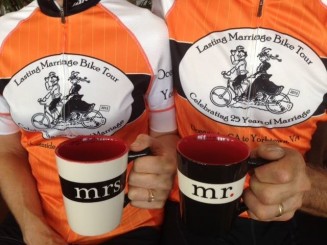
We have been cyclists for all of our married life and we thought how fun it would be to ride our bikes across the United States, a dream that we had almost forgotten amongst the days and years of work and family life. With both kids grown and off on their own, we decided this was the way we would celebrate our 25th Wedding Anniversary – on a tandem ride across the United States. But we didn’t want this ride to be just about us. We wanted to somehow help others in their own marriages. So from Oceanside, California to Yorktown, Virginia we searched for couples who had helpful advice on what makes for a happy, lasting marriage.

Starting off at the Pacific Ocean

Our journey began on June 27, 2015 with a great send-off. About twenty friends and relatives joined us for breakfast in Oceanside including Karen, one of the friends that had introduced us to each other in college. From there we rode for 40 days, taking one day off per week to rest. Every day we would find someone to interview asking them, “What advice would you give to people who are preparing to get married or who are newly married?” We would then post the advice with a description of our ride for the day and some photos on our Facebook page “Lasting Marriage Bike Tour.” On the page we also put some book recommendations, posted articles on marriage, listed marriage resources and 25 love songs that speak about true love.

Beautiful scenery in Colorado

Traveling through Monument Valley in Arizona

Experience is a great teacher if you take the time to reflect upon it, so we interviewed people who had been married for a long time. The advice we received from these friendly people, most of whom were complete strangers to us, is valuable advice that would help anyone trying to build a successful marriage. Quite a few of our followers commented how much they appreciated the advice; some couples saying that they read our posts every night before they went to bed. We pray that it will help many others.

Some Advice from People Across the U.S.

  • Have God in your life and go to church together
  • Never stop listening and never stop talking
  • Be your spouse’s best friend
  • Don’t be selfish
  • Learn to compromise, to give and take
  • Persevere, always remember why you got married
  • Tell your spouse how much you love them

We made it to the east coast on August 12th, 2015. Overall, we traveled through nine states and rode 3,360 miles. We met so many good people and saw many beautiful sights. What a great adventure and a great way to spend time together celebrating our anniversary!

Ric and Anne’s celebratory dinner in Yorktown, VA

How To Take Young Children to Mass

Sometimes at the end of Mass a parishioner comes up to us and says “Your three children are SO well behaved!” Our standard response is either, “Thank you. We work at it” or “Thank you, some days are better than others.” The “better” days are the product of years of articles and brochures we read on taking children to Mass. Here is the distilled wisdom we rely upon.

Before Church

  • Make sure children are well-fed right before Mass. They do not need to fast, nor will fasting help them to be on their best behavior during Mass. We personally do not think it is appropriate to take snacks into the pew. Our exception to this is a non-spill drink cup that bought us enough time to hear the homily once in a while.
  • Beginning even with the smallest infants, dress them in some special clothing that they wear only for church or other special events. This does not have to be expensive and can be as simple as a nice pair of shoes. It helps them to identify what we do at Mass as different from everyday activity.
  • Check your diaper bag to make sure it is stocked for any possible needs. Consider including a small toy or book that your child sees only on Sunday at Mass. These should be quiet and made of soft material so that they do not distract those around you from their prayer while they are being played with or in case they are dropped.
  • Put on a fresh diaper or visit the bathroom right before walking out the door of your home or into the church.

For toddlers or older children

  • You might read the readings in the car on the way to church. This could even be the job of an older child. Then everyone hears them at least once in case someone has to step out during a portion of the Mass.
  • Before going into the church take a moment to remind children what you are about to do. Make sure they know what their job is at Mass. For us, we say that their job is to be quiet/still, to participate by sharing their voices and to pray. Their job is also not to distract those around them from praying.

At Church

  • Sit up front. Yes, sit even in the first pew if it is appropriate at your parish. It can feel scary and even a little out of control the first few times, but it makes a world of difference for little ones to be able to see the action. Over time it also helps them to understand what is most essential about Mass without the distraction of rows and rows of backsides between them and the altar.
  • We physically hold our children in our arms during Mass. In fact, we adopted the position that our children’s feet do not touch the ground during Mass until they are three years old. This helps in many ways. The children get a get a better view; as they grow and mature we can talk them through the stories and the actions; and we have a bit more control over their behavior. If an infant or toddler gets squirmy, often switching who is holding them is enough to calm them down. Otherwise we might play a quiet game of “point to the…candles, priest, altar, cross, etc.”
  • During their two-year-old year, we begin to let our children stand for a portion of Mass or try sitting next to us quietly, instead of on our laps. Then when they turn three it is a special milestone to be big enough to stand, sit and kneel all on their own (although if they can’t see over the pew we have them stand during the kneeling portions of the Eucharistic Prayer).
  • If an infant or toddler makes a little noise during Mass and settles down right away, try not to feel self-conscious. Most folks except for those closest to you do not even notice. And even if they do notice, give your fellow parishioners credit for being adults who can focus through a small distraction.
  • If a child cries or makes continual noise, it is best to calmly step out of the pew and take the child out of the main assembly until they have calmed down or are quiet. However, it is important to return to the worship space as soon as they are quiet, so that children do not begin to associate poor or disruptive behavior with a pass to get out of Mass. Just stand against the wall until it is appropriate to return to the pew. Our experience is that stepping out and returning even a few times is not nearly as disruptive as a crying baby and parishioners appreciate your consideration of their attempt to pray. Those that are parents understand completely.

After Mass

  • Praise your children abundantly for their good behavior.
  • If they need some improvement, mention briefly how they might do better next week and explain why. Let them know that you will help them by trying to remind them before the next Mass.
  • Answer questions children have about Mass and encourage them to understand the liturgy and its place in our lives.
  • For older children consider taking time to discuss the readings and the homily.

In taking our children to Mass we operate on the principle that we need to teach our children how to be in church as long as it does not distract others around us from their prayer. Some days are better than others, but the gift of passing on how we pray as Catholics is worth all of the challenges.

As parents, and leaders of our domestic church, we are responsible for forming our children in our Catholic faith. There is no more important experience to Catholics than the Mass, so it is crucial to help children understand and participate in liturgy as much as they are able. At times, it has seemed as though the only thing we accomplished at Mass was the exercise of standing and walking with a grumpy baby. But we also know that children do not remain little for long and they rise to our expectations. We will have plenty of opportunities to experience transcendent prayer at Mass when our children are teenagers or out of the house. For now, though, our primary job is to make sure they “get” what happens at Mass. We find that God has found ways to feed us, even on the most difficult of days with a teething toddler.

We acknowledge with immense gratitude Mary Ann Kuharski and Elizabeth A. Ficocelli for articles that made all the difference. Elizabeth Ficocelli’s article “Avoiding Mass Hysteria: Teaching Children to Behave in Church” was published in America Magazine. Her work can be found at www.elizabethficocelli.com.

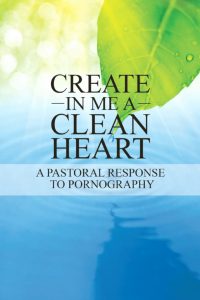
“Create in Me a Clean Heart: A Pastoral Response to Pornography”

At their November 2015 General Assembly, the bishops of the United States overwhelmingly approved a formal statement that addresses the many harmful effects of pornography use and offers a word of hope and healing for all the men, women, young people and children who have been negatively affected by pornography.

Called “Create in Me a Clean Heart: A Pastoral Response to Pornography,” the full statement is available online at this link: www.usccb.org/cleanheart. The abridged version is available for purchase here.

Bishop Richard J. Malone, chairman of the Committee that spearheaded the statement’s development, said: “My brother bishops’ approval of this statement shows our collective concern for the widespread problem of pornography in our culture today. As the statement says, virtually everyone is affected by pornography in some way. So many people – including within the Church – are in need of Christ’s abundant mercy and healing. My hope is that the statement can serve as a foundation and catalyst for increased pastoral attention to this challenge at the national and local level.”

Resources for married couples struggling with pornography use can be found on For Your Marriage in the “Overcoming Obstacles: Pornography” section.

Tinsel or Garland?

Tinsel or garland? Real or fake?

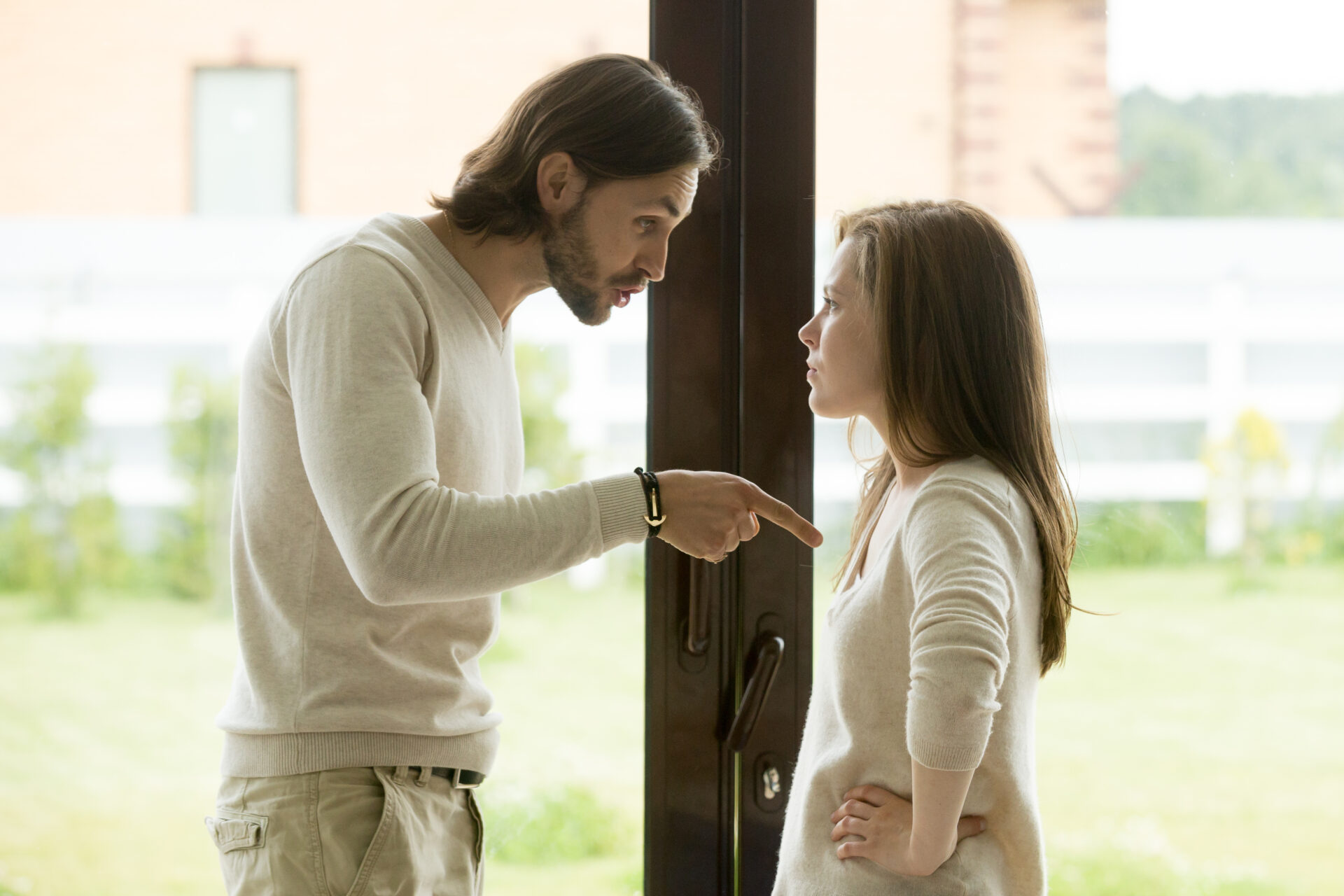
In our first year of marriage, that was our first major argument as a couple. We were looking forward to our first Christmas together, and each of us had our family traditions in mind when we imagined what that might look like. Paul had grown up with tinsel-covered artificial trees, put up over Thanksgiving weekend. Sarah’s family had real trees, wrapped in garland that they bought only a few days before Christmas.

So when the holiday season arrived in our house for the first time, we had to figure out what we would do. After some heated discussions and some false accusations (such as: “You don’t care about my family, do you?”), we finally came to a decision: garland on a fake tree, put up the first or second week of December.

Some might call this a merger, but in reality, it was something better. Merging traditions would mean we had a hodgepodge of this and that from each of our family rituals. And while we did some of that initially, it never truly satisfied.

What we discovered that first Christmas is that we needed to create our own traditions, some borrowed from our respective families, but most of it from ourselves.

Creating new traditions, unique to us as a couple, has been one of the most enjoyable aspects of each passing holiday season (and yes, we mean “holiday” because it encompasses new traditions at Halloween, Thanksgiving, Christmas, and New Year’s).

In the past few years, we have created all kinds of new traditions at Christmas. On Christmas Eve, we often get a hotel room in downtown Chicago or one of the other suburbs (because hotels are really affordable on that particular day of the year), have a nice dinner, and head out to a Midnight Mass near the hotel. Another tradition we have is pulling out and watching our favorite Christmas movies by the fireplace, or finding a movie theatre that’s showing a classic like “White Christmas” or “It’s a Wonderful Life.” These and other moments are unique to the two of us, unlike anything Sarah’s or Paul’s families did when we were growing up.

The oddest thing that has come with creating our new traditions is the disorienting feeling we have had if and when we head “home” at Christmas. One year, we went to Philadelphia to visit Sarah’s family, and while it was wonderful to reconnect with everyone, it didn’t feel like “home” anymore. Instead, that warm, special feeling came when our plane touched down at O’Hare Airport. We had come “home” to the place where our new traditions were forged and nurtured.

It might be bittersweet to leave our old traditions, but it is even more exciting to create new ones (like garland on a fake tree) that are unique, special, and fitting just for us.

Questions for Discussion:

  • What will you do as a couple this holiday season that will focus on religious side of your partnership?
  • Why are traditions an important part of our lives?
  • What family traditions have you appreciated most?
  • Which traditions are you not willing to let go?
  • How can these be incorporated into your spouse’s desires?

About the authors
Sarah and Paul Jarzembowski were married at Holy Name Cathedral in Chicago in 2002. Sarah, who was born and raised in the Archdiocese of Philadelphia, currently works as the national partner program coordinator for Charis Ministries, a Jesuit outreach and retreat ministry for young adults in their 20s and 30s. Paul, who originally hails from the Diocese of Gary in Indiana, serves on staff at the U.S. Conference of Catholic Bishops as an assistant director for the Secretariat of Laity, Marriage, Family Life and Youth. They currently live in the Maryland suburbs of Washington, D.C.

This article was originally published on the website of the Family Ministries Office of the Archdiocese of Chicago: www.familyministries.org. Reposted with permission.

A Special Family: Shaped by Down Syndrome, Grief and Grace

By the time our son Stephen turned seven, we were hoping to adopt another child. To our three birth children, Guy (8), Stephen (7), and Matthew (5), we had already added David (3) and Danny, whose Down syndrome no longer seemed remarkable. He had passed the ripe old age of one and, although he was developing more slowly than our four older boys, he was making strides at his own pace. Other than a small PDA (a patent ductus arteriosusa or small hole in his heart) and the croup which scared us all half to death, he was in good shape physically. (The hole eventually closed, and he outgrew the croup, thank God!) Except for the time I fed him too many carrots and turned his skin orange, we were doing a pretty good job of parenting. Danny had grown into being just another member of the family, and we felt that we could care for one more baby with special needs. Down syndrome did not seem like a disability. It was a challenge which early intervention services helped us to meet.

The following spring, we met John Francis in The New York Foundling Hospital. He was four months old. The first time I held him, he looked up at me and smiled. (I refuse to believe it was gas!) I was a sucker for cute babies, and his little face won me over. Like Danny, John Francis had a small PDA. This was not an issue, but the colostomy bag attached to his little abdomen did present some problems. I had to learn to care for it before The Foundling would release him to us, and that made me nervous. But he had that adorable little smile and I soon managed to clean out his bag, “like a pro,” one of the nurses said, as though his guardian angel was guiding my hands. Looking back now, I think perhaps he was!

Our first night at home, I had a slippery little mess on my unskilled hands. I think that was the only time I wondered about the wisdom of our decision! My sister, who was present for my struggles and frustrations, suggested that I use a meat baster to flush out his little bag. That solved my biggest problem and I continued to use that baster until his colostomy was reversed by the time he was two.

The other boys did not like the idea of the colostomy bag, although it was covered up and soon became a non-issue. They were also against us naming the baby “Francis.” They thought the kids in the neighborhood would make fun of him. I had to laugh at that. Here was this little Chinese baby with Down syndrome and a colostomy bag and they were worried about kids making fun of his name! But we compromised on that, and named him John Francis instead. To my knowledge no one has ever made fun of him or of his name!

After his slippery beginning, John Francis found himself the littlest child in a busy household. We had decided, even before adopting Danny, that our family life would not change because of the addition of children with special needs. We went to Church, took them all to McDonald’s, went shopping and on vacation. Other than toting more luggage, along with the usual baby paraphernalia plus that necessary baster, we managed. My husband took the older boys to their sporting practices and events. I stayed home with the little ones, and joined him when I could. We were a typical family, busy in the chaos of everyday life.
Russo 2 children

All of the boys got along, but Stephen took a special interest in John Francis. They were “roomies” and Stephen seemed happiest when he was holding the baby in the crook of his arm. I can still see the look of pure joy on his face as he went about the house toting John Francis with him. They went to bed and crib, as usual, on the night of February 12, 1990, but Stephen came out of his room about 10 p.m. in distress. He had a terrible headache and could not sleep. I gave him some pain reliever and put him back to bed. I could soon see that this was not an ordinary headache. We called for an ambulance and, by 3 a.m. the following morning, Stephen was dead. His undetected brain aneurism had burst suddenly, without any warning. That is what made us a “special family”: grief, not Down syndrome.

A family does not get over the death of a child. As time went on, we began to function again, but it was very difficult. The older boys mourned Stephen quietly, and my husband, Tony, sank into a deep depression. The laundry did not stop, the house did not stay clean, and the meals did not cook themselves. I managed to get through some very difficult days bearing the brunt of a loss which nearly paralyzed us all. Losing Stephen was the greatest challenge of our lives.

I knew that, in order for me to heal, I had to give myself over to something greater than my loss. It seems incredible to me now that my husband, Tony, went along with my desire to find another baby, but he did. We began to actively pursue another adoption and were led back to The New York Foundling Hospital the following year.

A baby girl with Down syndrome had been born in January of 1991. She had a large hole in her heart and lay, we were told, like a little blue doll. The agency did not want us to meet her until after her surgery. They were afraid she might not survive, and did not want us to face what would be another devastating loss. A lot of prayers were sent up to heaven during the next few months! After the surgery, we were finally called in to meet her.

Now this little bundle was a challenge of a different sort! She had not developed the ability to suck and swallow. On the positive side, her heart had healed well and her prognosis was good. I faced the daunting task of putting a tube down her nose into her tummy four times a day so that she would be able to get the nourishment she needed to thrive. I was to do that after I coaxed her to drink from a bottle, something she never quite mastered. I did not know if I was up to this task, this risk of giving our hearts to another child, at all.

After we met Maria Grace, I went to church. By then Stephen had been gone a year and a half. While sitting in the back of my parish church, I looked up at the altar, praying for guidance. There, my soul very clearly saw Stephen, holding a little baby out to me in his outstretched arms. It was as if he were offering me the gift of life. How could I reject it?

Again, angel hands seemed to guide my own as I learned to feed Maria Grace. We brought her home by the end of that week, another China doll, when she was seven months old and weighed less than eleven pounds. Matthew, our youngest birth son, had taken over Stephen’s place as “roomie” and chief holder of John Francis. I was able to devote my time to the baby’s careRusso 3 children resized
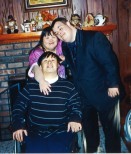
Our children are now grown. Our oldest son, Guy, works in a school with a boy who has Autism. He hopes to teach full time in September. Matthew worked in a Day Program with adults with special needs for three years and is looking forward to teaching Social Studies in the fall. David was a “Buddy” with United Cerebral Palsy and also “buddied” while he served in the army. He will graduate from college this May. Danny and John Francis both go to work daily in Hub Sites, gathering places from which adults with special needs go out to serve as volunteers in the community. Maria Grace also volunteers at a Hub Site. This only daughter of mine has grown into a confident 23-year-old who has the ability to keep us all in our places. Even the dogs! Down syndrome has not been a disability for us. It has been, instead, the lens through which we, my husband and I and all of our children, have learned to love each other. You can see our story on YouTube at “What to Expect When You’re Expecting a Baby with Down Syndrome”. I hope that the smiling faces it contains suggest that Down syndrome is a gift, like life itself.

How has it been raising a family in which three members have Down syndrome? It has been a gift to treasure – and to share!
Domestic Violence

What’s the difference between normal conflict and domestic violence? Conflict is part of every intimate relationship–that’s why conflict resolution skills are important. Domestic violence, however, has no place in a healthy relationship, whether the couple is dating, cohabiting, engaged, or married.

What is domestic violence?

Domestic violence is any kind of behavior that a person uses, or threatens to use, to control an intimate partner. The two key elements are threat and control. Domestic violence can take various forms:

Physical – Violent actions such as hitting, beating, pushing, and kicking. In many cases physical abuse becomes more frequent and severe over time.

Sexual – Includes any sexual acts that are forced on one partner by the other

Psychological – Includes a wide range of behaviors such as intimidation, isolating the victim from friends and family, controlling where the victim goes, making the victim feel guilty or crazy, and making unreasonable demands

Emotional – Undermining an individual’s self-esteem, constant criticism, insults, put-downs, and name-calling

Economic – Examples include limiting the victim’s access to family income, preventing the victim from working or forcing the victim to work, destroying the victim’s property, and making all the financial decisions

Both women and men can be victims of domestic abuse. According to the National Domestic Violence Hotline statistics, approximately 1 in 4 women and 1 in 7 men over the age of 18 have been the victim of physical domestic violence, and almost 50% of both sexes have experienced some form of domestic psychological aggression.

Characteristics of victims

  • Female, although men can also experience domestic violence
  • Younger, often in their 20’s and 30’s
  • More likely to be dating or cohabiting than married
  • Nearly half live in households with children

Why do women stay?

Women often stay with their abusers because of fear. They are afraid that the abuser will become more violent if they try to leave. Some fear that they will lose their children. Many believe that they cannot make it on their own.

Some abused women believe that the abuse is their fault. They think that they can stop the abuse if they just act differently. Some cannot admit that they are abused women. Others feel pressured to stay in the relationship. They may feel cut off from social support and resources. Abused women often feel that they are alone, and have no where to turn for help.

Why do men batter?

Abusive men come from all walks of life. They may be successful in their career and respected in their church and community. Abusive men often share some common characteristics. They tend to be jealous, possessive and easily angered.

Many abusive men believe that women are inferior. They believe that men are meant to dominate and control women.

Typically, abusive men deny that the abuse is happening or they minimize it. They may blame their partner for the abuse, saying, “You made me do this.”

Alcohol and drugs are often associated with domestic violence but they do not cause it. An abusive man who drinks or uses drugs has two different problems: substance abuse and violence. Both must be treated.

What the Catholic Church teaches about domestic violence

The U.S. Catholic Bishops have made clear that “violence against women, inside or outside the home, is never justified. Violence in any form- physical, sexual, psychological, or verbal is sinful; often it is a crime as well.” (When I Call for Help: A Pastoral Response to Domestic Violence Against Women)

WHERE TO FIND HELP

For abused persons

  • Believe that you are not alone. Help is available for you and your children.
  • Talk in confidence to someone you trust: a relative, friend, pastor or family doctor
  • If you choose to stay in the situation, set up a plan of action to ensure your safety. This includes hiding a car key, personal documents, and some money in a safe place and locating somewhere to go in an emergency. For more information about safety planning go to the National Domestic Violence Hotline.
  • The National Domestic Violence Hotline provides crisis intervention and referrals to local sources of help in all 50 states. Call 1-800-799-SAFE (7233) or 1-800-787-3224 (TTY).

For those who abuse

  • Admit that the abuse is your problem, not your partner’s. Begin to believe that you can change your behavior if you choose to do so.
  • Be willing to reach out for help. Talk to someone you trust who can help you to evaluate the situation. Contact Catholic Charities or other church or community agencies for the name of a program for offenders.
  • Call the National Domestic Violence Hotline (1-800-799-7233) for information about where to find help.


Domestic violence and the permanence of marriage

Some abused women believe that Catholic Church teaching on the permanence of marriage requires them to stay in an abusive relationship. They may hesitate to seek a separation or divorce. They may fear that they cannot re-marry in the Catholic Church.

In When I Call for Help: A Pastoral Response to Domestic Violence Against Women, the Catholic bishops emphasize that “no person is expected to stay in an abusive marriage.” Violence and abuse, not divorce, break up a marriage. The abuser has already broken the marriage covenant through his or her abusive behavior. Abused persons who have divorced may want to investigate the possibility of seeking an annulment.

What the Bible says

Abusive men may take a text from the Bible and distort it to support their right to batter. They often use Ephesians 5:22 (“Wives should be subordinate to their husbands as to the Lord”) to justify their behavior. This passage (v. 21-33), however, refers to the mutual submission of husband and wife out of love for Christ. It means that husbands should love their wives as they love their own body, as Christ loves the Church.

The Catholic bishops condemn the use of the Bible to support abusive behavior in any form. Men and women are created in God’s image. They are to treat each other with dignity and respect.

Forgiveness

Men who batter also cite the Bible to insist that their victims forgive them (see, for example, Matthew 6:9-15). A victim then feels guilty if she cannot do so. Forgiveness, however, does not mean forgetting the abuse or pretending that it didn’t happen. Neither is possible.

Forgiveness is not permission to repeat the abuse. Rather, forgiveness means that the victim decides to let go of the experience, to move on with life and not to tolerate abuse of any kind again.

Resources

For Further Reading:

October: Domestic Violence Awareness Month

The month of October is Domestic Violence Awareness Month. The statistics on domestic violence are heartbreaking. According to the Centers for Disease Control and Prevention, one in four women, and one in ten men, have been the victims of severe physical violence by an “intimate partner” (boyfriend/girlfriend or spouse) at some point in their life. Over a third of all men and women have experienced psychological aggression by an intimate partner. Domestic violence starts early: over half of women and men who have experienced some form of domestic violence were victimized for the first time before they were 25 years old.

Domestic violence shatters the peace that should reside in relationships, especially in the family, the domestic church. St. John Paul II described the family as the “cradle of life and love.” Domestic violence replaces life with harm and even death; it replaces love with anger and fear. It breaks down trust between husband and wife, parents, and children. Sadly, it is a cycle that tends to be repeated in the next generation as boys imitate their abusive fathers and girls learn to expect abuse from men.

The Catholic Church’s Response: “When I Call for Help”

Behind the sad statistics about domestic abuse are individual persons, men and women made in the image of God. What has been the Catholic Church’s response to such a tragic experience for so many people?

In their statement “When I Call for Help,” which was published in 1992 and reaffirmed in 2002, the U.S. bishops unequivocally rejected domestic violence:

As pastors of the Catholic Church in the United States, we state as clearly and strongly as we can that violence against women, inside or outside the home, is never justified. Violence in any form – physical, sexual, psychological, verbal – is sinful; often it is a crime as well. We have called for a moral revolution to replace a culture of violence (p. 1).

“When I Call for Help” remains the touchstone of the Church’s response to domestic violence. In it, the bishops address four audiences: victims of domestic violence (predominately, though not exclusively, women), clergy and Church employees, abusers (predominately, though not exclusively, men), and society at large.

The statement first provides an overview of domestic violence, defining it as “any kind of behavior that a person uses to control an intimate partner through fear and intimidation” (p. 4). Abuse is not just physical (hitting, punching, etc.), but includes sexual, psychological, verbal, and economic abuse. The bishops also identify forced sterilization or abortion as a form of abuse.

The bishops say very clearly that domestic violence can never be justified by Scripture or Church teaching. “A correct reading of Scripture leads people to an understanding of the equal dignity of men and women and to relationships based on mutuality and love” (p. 9). They remind victims of abuse that they are not to blame.

And to victims who are abused by their spouse, the bishops state clearly that “no person is expected to stay in an abusive marriage” (p. 9). In this, they echo the Code of Canon Law, which states, “If either of the spouses causes grave mental or physical danger to the other spouse or to the offspring or otherwise renders common life too difficult, that spouse gives the other a legitimate cause for leaving [i.e. separation]” (canon 1153.1).

In the last section of “When I Call for Help,” the bishops provide suggestions for action for abused women, men who abuse, and pastors and pastoral staff, who are often “first responders” to a situation of abuse. The statement concludes with a prayer drawn from Psalm 55.

USCCB Resources

  • “When I Call for Help” is available online here or for purchase here. Also available are Resource Cards that give warning signs of abuse and a hotline number.
  • This Preaching Resource is meant to highlight specific readings that lend themselves to raising awareness of domestic violence.
  • This English/Spanish Sign, which includes the National Domestic Violence Hotline and space to add local resources, is designed for use in restrooms.
  • Life Matters: Domestic Violence – a pamphlet from the USCCB’s Pro-Life Secretariat.
  • More information can be found on the USCCB’s Domestic Violence Page.

Other Resources

Infant and Pregnancy Loss

The Church calls children “the supreme gift of marriage” (Gaudium et spes, n. 50). Losing a baby, whether through miscarriage or as an infant, is one of the deepest forms of grief and pain that a couple may endure.

Unfortunately, many couples often suffer without any support, as in the case when a couple loses a child before sharing that they were pregnant with others, or insufficient support because family and friends are unsure of what to say or do because of the difficulty and often suddenness of losing one so young.

If you or a loved one has suffered the loss of a child during pregnancy or infancy, know that help and resources are available.

For Your Marriage Resources

Catholic Ministries Supporting Grieving Parents and Families

  • Behold Your Child Developed by the Archdiocese of Dubuque to help provide hope and healing for parents and families who have experienced a life-limiting prenatal diagnosis, miscarriage, stillbirth, or infant death
  • Catholic Miscarriage Support Practical and spiritual support for Catholics who have lost a child to miscarriage
  • Elizabeth Ministry International Offers hope, help, and healing on issues related to relationships, sexuality, and childbearing
  • Emmaus Ministry for Grieving Parents Offers spiritual support to parents who have lost a child at any age, by any cause, no matter how long ago
  • Heaven’s Gain Ministries For the physical, emotional, and spiritual needs of families experiencing pregnancy loss: before, during, and after the delivery of their precious baby
  • Red Bird Ministries Guides individuals and couples through the complexity and trauma that happens with the loss of a child from pregnancy through adulthood

Additional Resources

Why Did the Risen Jesus Cook Breakfast for the Disciples?

I love food. My parents tell me that, as a little child, I was a mostly calm, happy-go-lucky kid—unless I was hungry. Then I turned into a monster. But once I found something to eat—serenity returned. Some of my family members say that little has changed with me in the many intervening years! I grew up working in my family’s food business. Stories about food get my attention.

Thus I’m a fan of the resurrection stories. They often involve food. In Luke, the risen Jesus walks unrecognized with two of his disciples. It was only after they arrived at the village of Emmaus, and Jesus broke the bread at the dinner table, that they finally recognized him. The story continues with Jesus appearing to a group of disciples and asking them, “Do you have anything to eat here?” They gave him a piece of baked fish. (Luke 24:13-48) Then there is the scene with Peter and other disciples after a long day of fishing. They see the risen Lord calling them from the shore. When they arrive, they find that he has cooked a breakfast of bread and fish for them and invites them to “Come, have breakfast.” (John 21:1-14) I’ll bet there were some eggs and pancakes on the side too!

All this talk about food makes me hungry. But it also makes me wonder why Jesus put such emphasis on eating. Maybe he was just hungry. Jesus did some other curious things right after the resurrection: like breathing on his disciples and inviting Thomas to actually touch his nail wounds and feel the sword gash in his side. Jesus seems to be going out of his way to assure his friends that it was really he who was present; not a ghost or vision. It was he, fully alive and in the flesh.

“‘The flesh is the hinge of salvation.’ We believe in God who is creator of the flesh; we believe in the Word made flesh in order to redeem the flesh; we believe in the resurrection of the flesh, the fulfilment of both the creation and the redemption of the flesh.” (Catechism of the Catholic Church n. 1015.)

These resurrection scenes drive home to us the importance of the flesh, that is, the human body. For Jesus, his physical body wasn’t just something that he “wore” while on earth, but part of his very being. And for us, our bodies are not something solely for this life which we forever discard at the time of death. As human beings, we are a beautifully mysterious combination of body and spirit. Just as in the Ascension, Jesus took his resurrected body with him back to the Father, we, too, at the end of time, will receive back our glorified body for entrance into heaven. The body is a profoundly good part of how God created us. The body is holy—thus what we do with our bodies really matters.

The newly canonized Saint John Paul II spent many years of his life reflecting on the meaning of the body. Drawing from the Bible and theology, he composed a work called the Theology of the Body. He explains that it is through the body, and the experiences of the body, that we most completely come to know ourselves and God. St. John Paul II makes this bold assertion:

“The body, in fact, and it alone, is capable of making visible what is invisible: the spiritual and divine.” (Feb. 20, 1980)

Over these next few months, I invite you to join me in exploring how our bodies help us to better understand ourselves, and the God who made us.

In May, spring takes hold and our senses are heightened. Our senses, working through our body, allow us to feel a warm breeze, enjoy a sunset, listen to music, share a handshake and give a hug. They also allow us to enjoy a burger off the backyard grill. And that makes someone like me quite happy about the Theology of the Body!

About the author
Fr. Chris Singer is chancellor of the Diocese of Erie and presented a lecture series on the Theology of the Body in the Fall of 2014. Reprinted with permission from FAITH magazine in the Diocese of Erie (Last Word column).

Be Her Joseph!

When we first married, my wife, Misty, and I were the typical secular couple. We relied on hormonal contraception. Due to bad side effects, that didn’t last long. Misty found out about Natural Family Planning (NFP) through a Catholic friend. Admittedly, I was suspicious of all the “hocus pocus” involving thermometers at o’ dark-thirty in the morning and observations written down in cryptic symbols on the NFP chart. That would all change in surprising ways once we got into living the NFP lifestyle.

Before having children, Misty had been an atheist and I had been an agnostic. With our first child, the miracle of life spurred a spiritual awakening in us. We realized the Holy Spirit had already led us into a Catholic life. Even after our conversion, however, NFP grew our relationship with each other and with God in ways we never expected.

We studied Pope John Paul II’s “Theology of the Body” and became excited about living out our faith and sharing it. It was thrilling to learn the compelling reasons behind the Church’s beautiful teachings on sex and marriage.

Much to my surprise, I also learned how grateful my wife was that I was willing to learn how her body worked. Sharing the family planning responsibility, as well as finding non-sexual ways of expressing affection and intimacy when we had good reasons to postpone pregnancy, strengthened our marriage and made me a better husband and father. When we became Catholic, I knew I wanted to be the spiritual leader of our family, but I didn’t understand what that entailed besides herding our children to church on Sundays. Through NFP and Scripture, I discovered that I had a choice in the kind of man— the kind of husband — I was going to be.

We often blame Eve for eating the forbidden fruit. But in Genesis, we learn that after taking a bite, she turned and offered the fruit to Adam, who was with her. Adam didn’t stop her and say, “This is a bad idea, let’s go.” He did not protect his wife, but stood by silently while the serpent convinced her to surrender her holiness and damage her relationship with God.

Then there was St. Joseph. When Joseph obeyed the angel who told him to bring Mary into his home, he was accepting the public shame and embarrassment of a pregnant fiancé. He sacrificed his personal honor and reputation to obey God and protect Mary and Jesus.

The choice for a husband is clear: he can be his wife’s Adam or he can be her Joseph. A man can stand by silently and allow his wife to suffer the physical and spiritual consequences of contraception. Or he can defend her virtue, body, and soul by using NFP. Today, contraception is accepted and expected. Any man who forgoes it for NFP will likely be exposed to ridicule and criticism. But as St. Joseph taught us, there are some things more important than the opinion of others. May we husbands choose to be Joseph to our wives!

About the authors
Tom and Misty Mealey have four children and live in the Diocese of Richmond.

Natural Family Planning Awareness Week is celebrated each July, to mark the anniversary of Pope Paul VI’s encyclical Humanae Vitae. Learn more here.